
Claro Solutions brings rigorous, structured business analysis to complex organizational challenges — translating ambiguous problems, competing stakeholder priorities, and constrained options into clear, actionable intelligence. Our work spans technology platform assessments, options analysis, and enterprise governance reviews for public sector and not-for-profit clients across Canada.
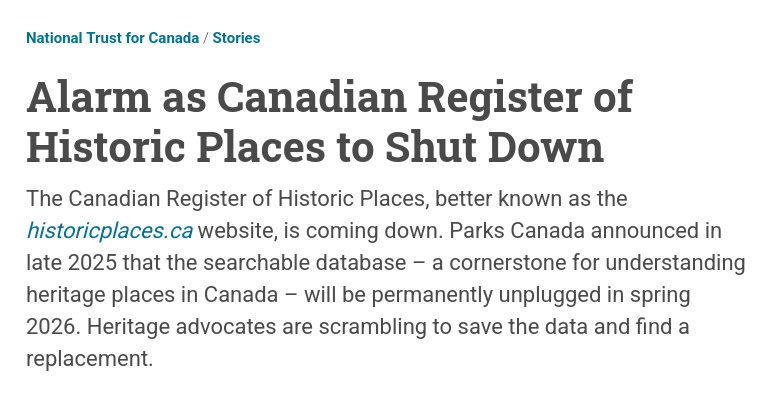
Featured Engagement: Canadian Register of Historic Places Options Analysis
Client: National Trust for Canada | In Partnership with Parks Canada
When Parks Canada announced the shutdown of the Canadian Register of Historic Places – Canada’s only national, publicly accessible directory of recognized heritage sites – the heritage community mobilized quickly. Researchers, planners, educators, and community groups across the country had long depended on the Register to identify, understand, and protect historic places. Its loss threatened decades of collaborative documentation built through a federal-provincial-territorial partnership spanning every jurisdiction in the country.
The National Trust for Canada responded by launching a comprehensive options analysis to determine a viable path forward for a renewed Register. They engaged Claro Solutions to lead the technology component of the study.
The study’s goal was to analyze technical, functional, and governance options for a renewed Register and make recommendations – with a particular focus on how technology, including AI, could make the Register easier to manage and more useful to users.
Our Team
Adam Chernenkoff, Founder and CTO of Claro Solutions, led the technology platform assessment and options analysis. Darci Greenfield, Senior Governance Analyst and a senior advisor with Soteria Protection, contributed governance, risk, and stakeholder analysis – ensuring the options presented were not only technically sound but organizationally viable across a complex multi-jurisdictional landscape.
Our Work
Claro’s engagement encompassed three integrated streams:
Technology Assessment and Platform Options Analysis. We evaluated candidate platforms against the functional, technical, and sustainability requirements of a renewed national register – assessing their capacity to support publicly searchable listings, multi-jurisdictional data contributions, long-term data integrity, and alignment with established Canadian heritage conservation standards. National and international comparisons informed the analysis, drawing on deployments of comparable heritage information systems.
Stakeholder and Governance Analysis. The Register was originally created through a federal-provincial-territorial partnership and serves as a public resource listing thousands of recognized heritage places. A renewed register would require the continued participation of provincial, territorial, and federal data holders whose willingness to share information is essential to the tool’s long-term viability. Our work mapped these relationships and assessed governance structures that could sustain a future register beyond any single federal program’s lifecycle.
Data and Functional Requirements. With approximately 700 public survey respondents and direct engagement with jurisdictional data holders underway, Claro synthesized technical and user requirements into a clear picture of what a successor platform needed to deliver – and what it would take to build, migrate, and operate it sustainably.
“I very much enjoyed working with you and the team. You did a remarkable amount of work in a short time. I am particularly pleased with the engagement process.”
Patricia Kell | National Trust for Canada
Why It Mattered
The Canadian Register of Historic Places plays a key role in protecting and promoting heritage sites across the country. Researchers, planners, teachers, and community groups rely on it to identify and understand historic places, while the public uses it to learn about the history of everyday landmarks. The stakes of getting the analysis right – technically, politically, and practically – were high.
This engagement reflects Claro’s core approach to business analysis: evidence-based, stakeholder-grounded, and oriented toward recommendations that decision-makers can actually act on. When organizations face high-stakes choices under time pressure and across complex multi-jurisdictional dependencies, we provide the structured analysis needed to move forward with confidence.
Ready to turn a complex problem into a clear path forward?
Whether you’re facing a platform decision, a governance gap, or a question your organization can’t quite frame – Claro brings the structured analysis to get you unstuck. Let’s talk about what you’re working through.